
D1.8.8: The Law of Inheritance
Metadata
D1.8.8: The Law of Inheritance
Newspaper Clippings
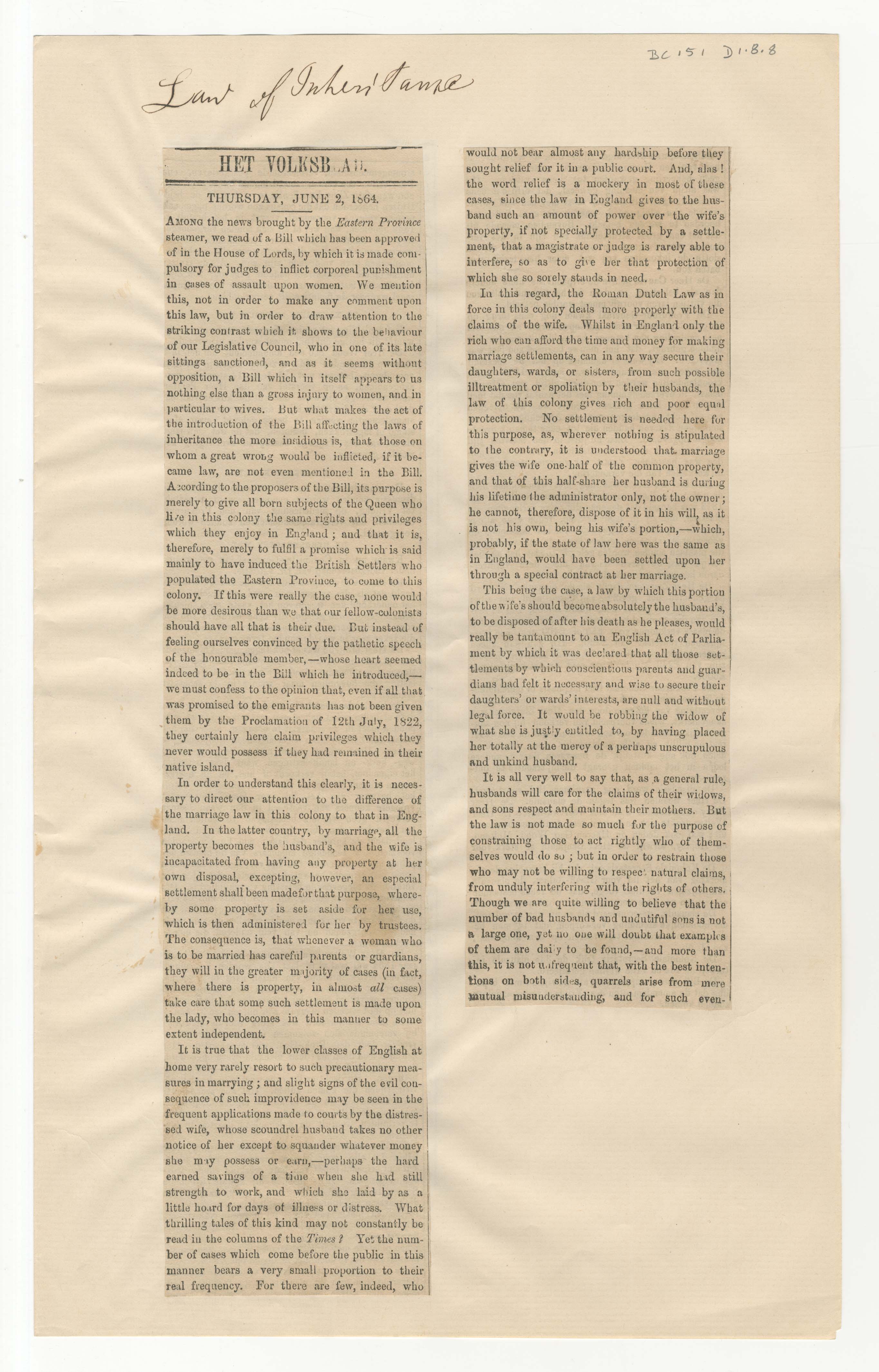
Bleek discusses marriage law distinctions concerning the Law of Inheritance and the alienation of complex assets in Roman-Dutch Law and the divergent English Common Law systems. The Western and Eastern Provinces disagree on which system best serves the public interest. Bleek recommends Roman-Dutch Law's superior protection of women's and children's assets from those who may otherwise lawfully squander them. Bleek maintains that the less emphatic English Common Law is more susceptible to abuse, burdening parents (on a presumption of literacy) with the formulation of settlements.
Printed newsprint glued on paper
02 June 1864
Two cut-out columns of printed newsprint mounted on foolscap folio (warped). 'Law of Inheritance' is the title Bleek wrote on the mount.
Law of Inheritance (a Bill affecting the), bills (introduced by the Legislative Council), steamer (news brought by), assault (upon women), Legislative Council (its behaviour), British Settlers (who populated the Eastern Province), July twelfth Proclamation (in 1822), marriage law (differences in)
Pressed clippings of Victorian current affairs opinion pieces by Wilhelm Bleek. Published in Het Volksblad on Thursday, June 2nd, 1864. Roman-Dutch Law offers an innate protection, whereas English Common Law is Classist in its operation. Settlements were typically drawn up at the time of a marriage (e.g., a trust of land). This subject may derive from the Lloyd sisters' unpleasant experience with their father involving a direct bequest left to them by their mother (Bank, 2006: 48). See items C4-8 (letters between JC Lloyd and WHI Bleek) in our online collection titled 'Correspondence'.
Van de Sandt de Villiers & Co.
Contributions