
D1.8.9: The Graham's Town Parliament
Metadata
D1.8.9: The Graham's Town Parliament
Newspaper Clippings
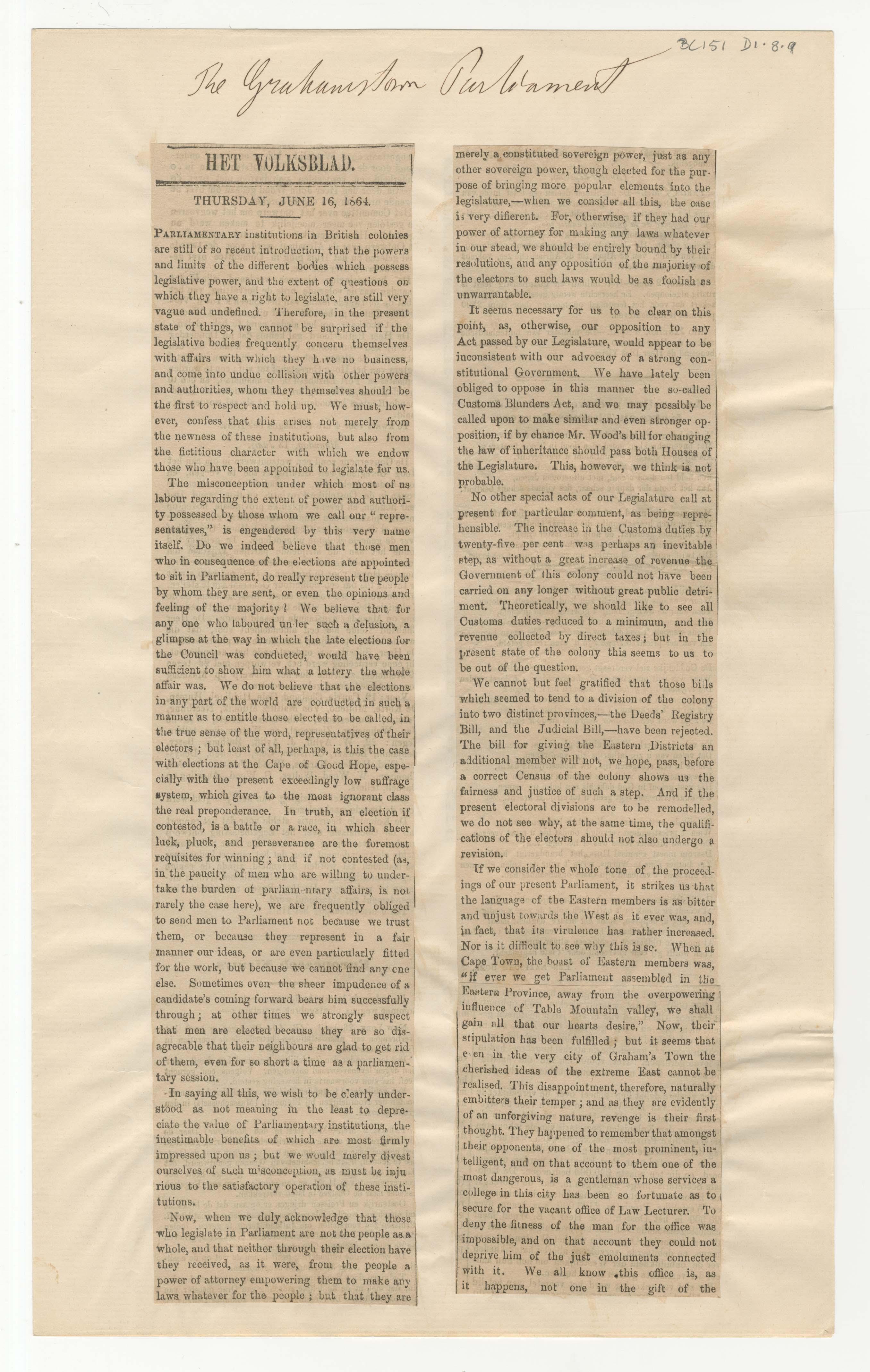
Bleek reflects on the newness of parliamentary institutions in British colonies and how their unclear legislative powers make them liable to encroach upon other remits. The Cape electorate overestimates the fidelity and powers of their representatives, selected from a small pool of unideal candidates. These representatives are not given power of attorney over the public, who retain their agency along with means of redress should legislators craft legislation that is unconstitutional or repugnant to them. In that vein, Bleek cites the Customs Blunders Act, the Deeds Registry Bill, the Judicial Bill, and George Wood's partially ratified bill as divisive incompatibilities symptomatic of the rivalry between Cape Town and Graham's Town, threatening to split the colony in two as Eastern members grow bolder and embittered. 'Easterners' advocate parliament's removal to Graham's Town as a remedy for Capetonian hegemony. Bleek ends with Frederick Watermeyer's suitability for the vacant law lectureship at the South African College.
Printed newsprint glued on paper
16 June 1864
Two cut-out columns of printed newsprint mounted on foolscap folio (warped). 'The Graham's Town Parliament' is the title Bleek wrote on the mount.
Graham's Town (relocating parliament to), limitation of powers (unclear institutional jurisdictions), Customs Blunders Act, Mr George Wood, law of inheritance (separate laws split us into two distinct provinces), Deeds' Registry Bill (has been rejected), Judicial Bill (has been rejected), census (to redraw electoral divisions), Table Mountain valley (its overpowering influence on colonial politics), Frederick Watermeyer (his suitability as law lecturer)
Pressed clippings of Victorian current affairs opinion pieces by Wilhelm Bleek. Published in Het Volksblad on Thursday, June 16th, 1864. The controversial opening of the Parliament of the Cape of Good Hope at Graham's Town on 24 April 1864 was the only parliamentary session held away from Cape Town. Governor Wodehouse delivered a speech at that controversial opening of parliament. At this time, the Cape Colony adhered to its Imperial Government-granted 1854 constitution (granting it representative but not responsible government), the colony's first and only written (codified) constitution.
Van de Sandt de Villiers & Co.
Contributions