
D1.8.11: Mr Chabaud's resignation and what came of it
Metadata
D1.8.11: Mr Chabaud's resignation and what came of it
Newspaper Clippings
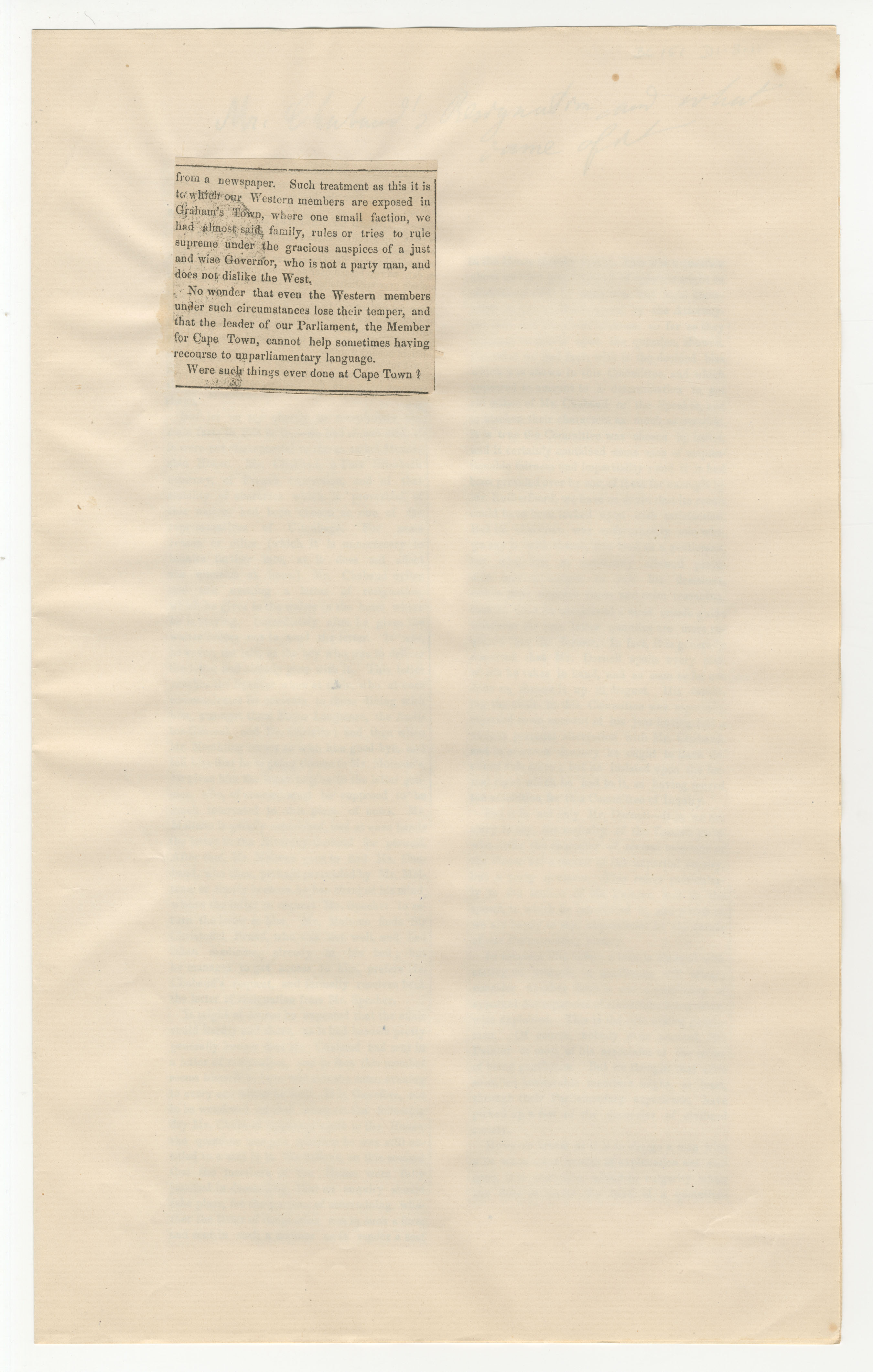
Bleek recounts the abrupt resignation of Mr Louis Chabaud, a Port Elizabeth attorney chosen to represent Uitenhage, whose impulsive resignation letter was sent hastily by a waiter to the Speaker of Parliament, Sir Christoffel Brand. Mr Neethling, who had been with Brand, is going to see John Molteno and is asked by Brand to show Molteno the letter. Thereafter, Molteno searches for Chabaud and persuades him to ask Brand for a retraction. Despite Brand allowing Chabaud's retraction, upon reporting to the House of Assembly as a representative, Chabaud's membership is challenged and made subject to review by a Committee of Inquiry to be chaired by Mr Darnell. Mr Painter's speech and motion stress this concern. Darnell, an Eastern party member who recently had a violent altercation with Chabaud, is unlikely to be objective.
Printed newsprint glued on paper
09 July 1864
One cut-out column of printed newsprint mounted on foolscap folio (warped).
Members (Western and Eastern), faction (a small one in Graham's Town), Sir Philip Wodehouse (Cape Colony Governor), leader of parliament (the Cape Parliament)
Pressed clippings of Victorian current affairs opinion pieces by Wilhelm Bleek. Published in Het Volksblad on Saturday, July 9th, 1864. 'Mr Painter' is likely Richard Joseph Painter (the MP for Fort Beaufort). It is unclear whether 'leader of parliament' refers to Saul Solomon (the leader of the 'Westerners'), who is not herein named, or Sir Christoffel Brand. As Speaker, Brand is a leader of parliament, so to speak, but is not a member representing Cape Town (which Solomon represented). Notably, Bleek describes Solomon as 'Cape parliamentary leader' in his 6 April 1865 'Leader'.
Van de Sandt de Villiers & Co.
Contributions