
D1.8.14: Coroner's Inquest wanted
Metadata
D1.8.14: Coroner's Inquest wanted
Newspaper Clippings
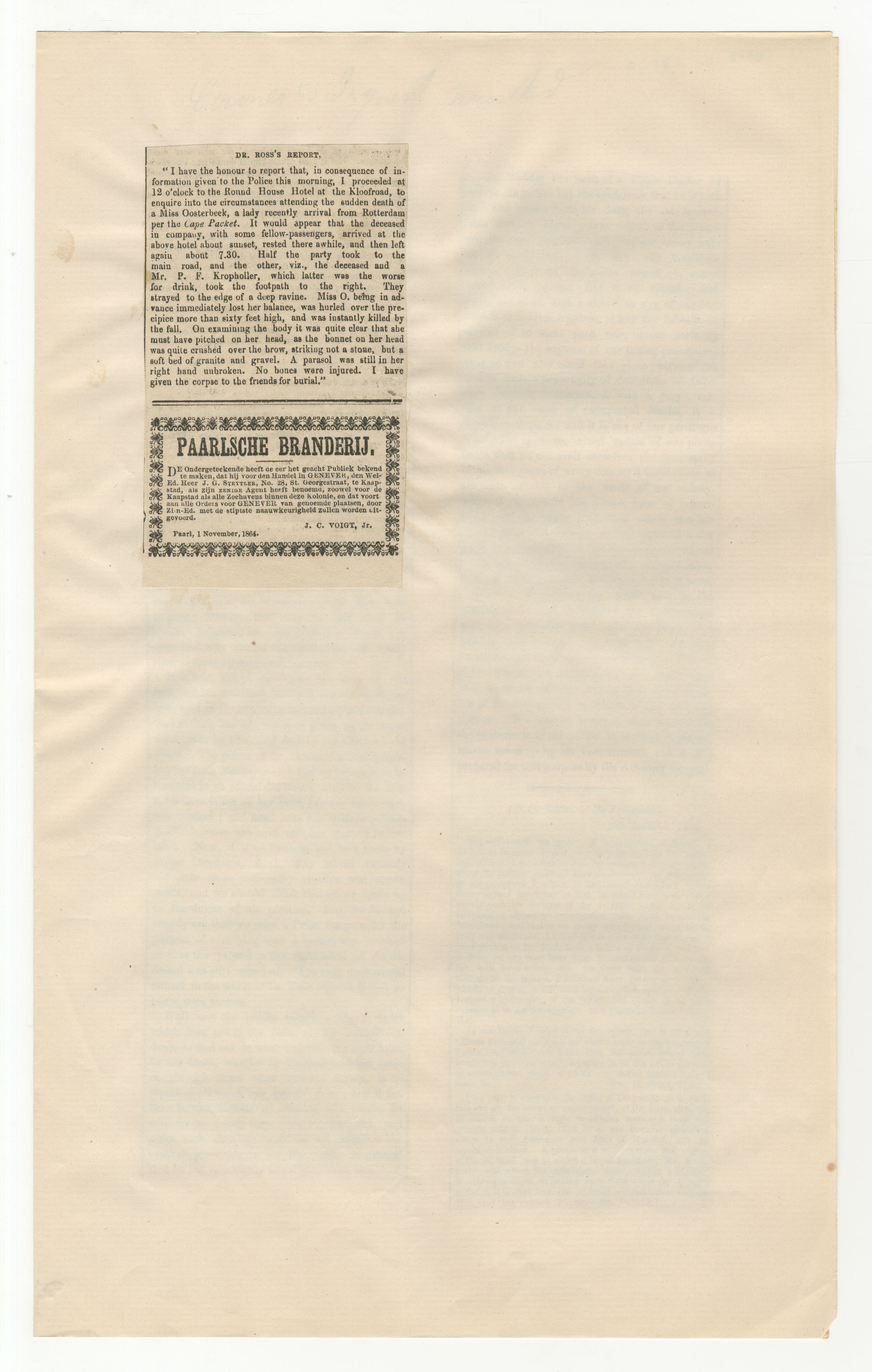
Bleek criticises the investigative rigour of Police Surgeon Dr Ross's report on the mysterious death of Miss Oosterbeek, a young Rotterdammer holidaying in Cape Town. He uses this case to query the general inadequacy of the colony's police services as an institution when investigating the proper causes behind increasingly frequent and suspicious unsolved local deaths. Bleek speculates that the rise in unsolved cases stems from procedural laxity or the incompetence of officials, taking particular exception to the inane details drawn upon in Ross's report that do little to uncover the truth or reduce the mystery. Bleek argues that a British-style coroner's inquest (an institution pursuing fact-finding rather than fault-finding) is needed, as perpetrators escape justice through a lack of thorough investigation. He encourages William Porter and parliamentarians to devise such a bill. Finally, he suggests hybridising the preferred Dutch Law of Inheritance (which better protects married women) with the superior constitutional rights and liberties captured in English Common Law for women more generally.
Printed newsprint glued on paper
22 December 1864
One cut-out column of printed newsprint mounted on foolscap folio (warped).
Dr Ross (his report), Round House Hotel (at the Kloof Road), Miss Oosterbeek (her sudden death), Rotterdam (Oosterbeek's arrival from Rotterdam), Cape Packet (her arrival came via the), main road, Mr PF Kropholler (his inebriation), footpath (which Kropholler took with Miss Oosterbeek), corpse (given to Oosterbeek's friends for burial)
Pressed clippings of Victorian current affairs opinion pieces by Wilhelm Bleek. Published in Het Volksblad on Thursday, December 22nd, 1864. The clippings include a 'Dutch' advertisement for Paarlsche Branderij in connection with JG (Johan Georg?) Steytler and JC (Johan Carel?) Voigt Jr.
Van de Sandt de Villiers & Co.
Contributions