
D1.8.18: Native affairs
Metadata
D1.8.18: Native affairs
Newspaper Clippings
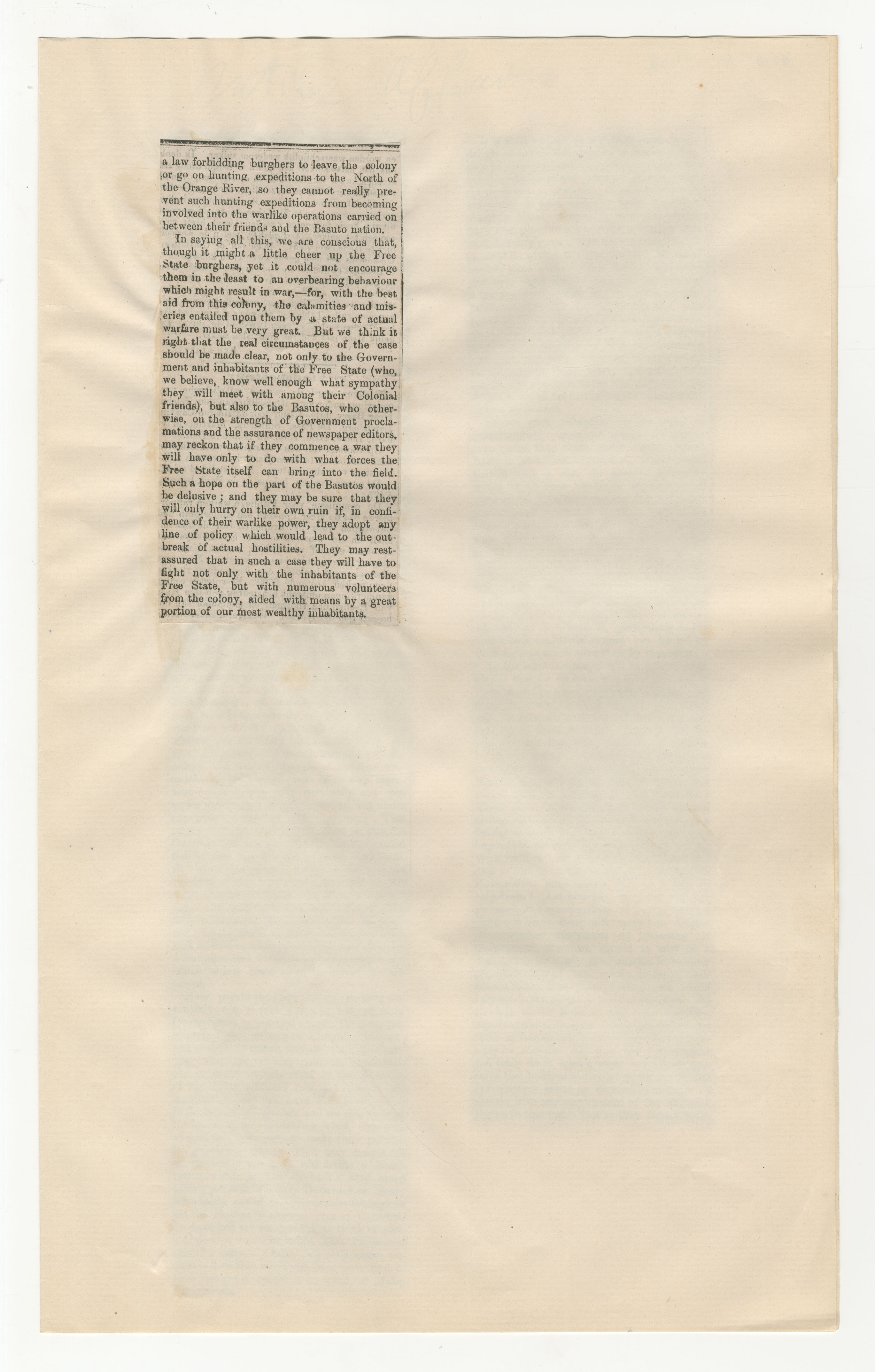
Bleek examines race relations and race distinctions as the cause of conflict in the American, New Zealand, and South African contexts. He submits that the exclusion of natives from New Zealand's parliament, where decisions were made (particularly about land) for them paternalistically, incited the New Zealand Wars. Bleek follows this with his view that the Cape's coloured population would not resort to war, while alluding to periodic 'Hottentot rebellions' and 'Malay disturbances', as they enjoy 'the same privileges' as white citizens (i.e., the Cape Qualified Franchise). However, he qualifies this with the admission that their lack of (quality) education renders them 'without political importance', leaving the bulk of decision-making to 'the higher civilised race'. He appears confident that the Free State-Basuto conflict is unlikely to escalate further before one side sues for peace. Furthermore, Bleek writes that the 'native squatters' in Natal must be converted into landowners to avert catastrophic conflict and help advance the settlement where only a few thousand settlers reside yet feel entitled to make decisions unilaterally. He ponders how to prevent Cape Colony inhabitants from intervening in the Basuto-Free State conflict.
Printed newsprint glued on paper
12 January 1865
One cut-out column of printed newsprint mounted on foolscap folio (warped).
Law (forbidding burghers to leave the Cape Colony), interference (by Cape colonists in Free State-Basuto matters), Basuto (their nation of Basutoland), war (Free State-Basuto War), burghers (of the Cape Colony and Free State)
Pressed clippings of Victorian current affairs opinion pieces by Wilhelm Bleek. Published in Het Volksblad on Thursday, January 12th, 1865. Bleek discourages either side from escalating hostilities, as the Basutos may outnumber the Free Staters but would face an existential crisis at the hands of a unified settlerdom.
Van de Sandt de Villiers & Co.
Contributions