
D1.8.5: The Graham's Town Customs Act
Metadata
D1.8.5: The Graham's Town Customs Act
Newspaper Clippings
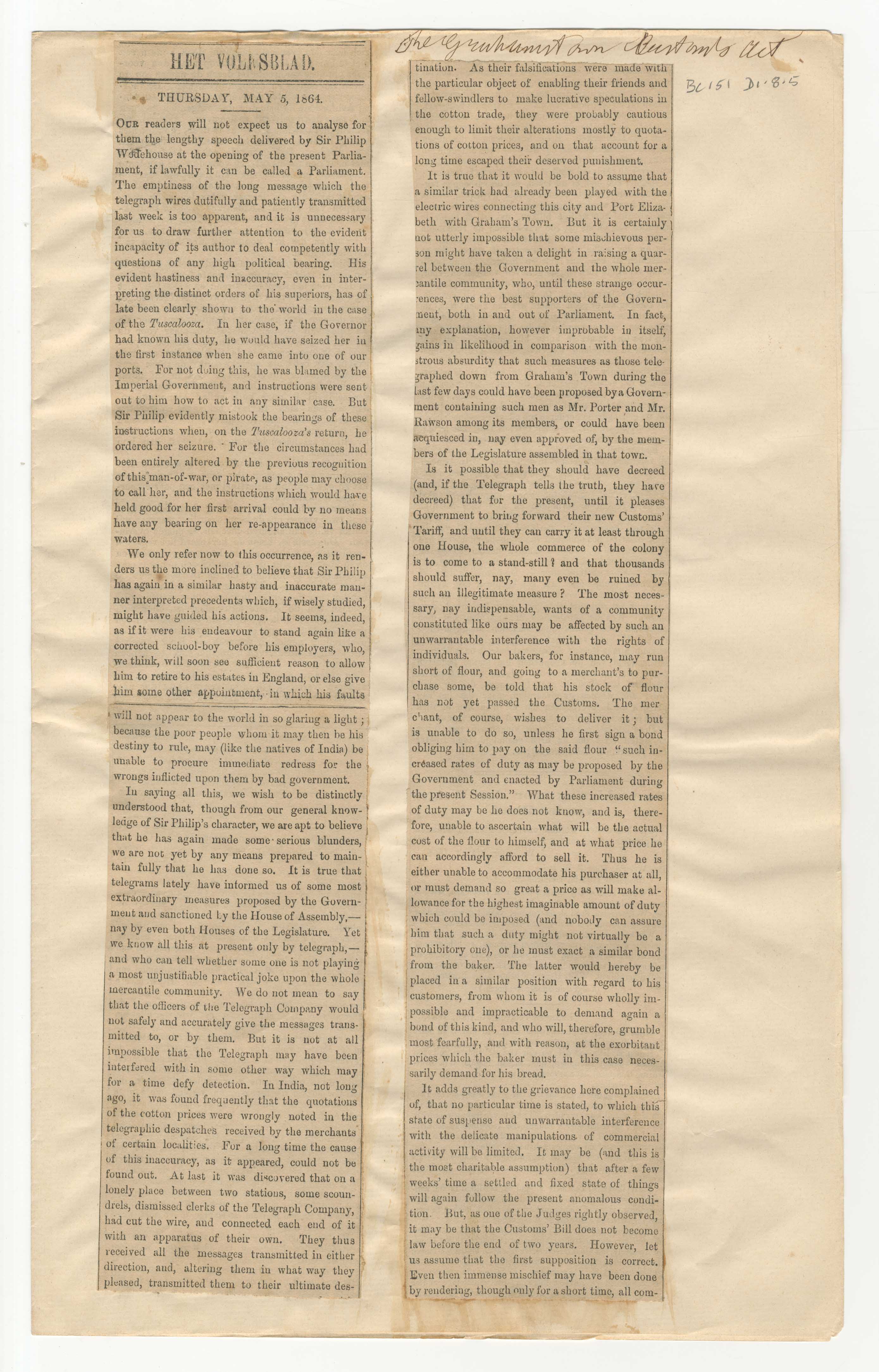
Bleek criticises the Cape Colony Governor, Sir Philip Edmond Wodehouse, for his delayed and now problematic seizure of the CSS Tuscaloosa (now a [stolen] Confederate cruiser) upon its return to Simon's Bay in 1864. It was previously the Union's federal bark Conrad. Wodehouse is unaware of the vessel's new affiliation, which results in a geopolitical blunder for the Home Government to diffuse. The Tuscaloosa incident typifies Wodehouse's standard misconstruction of orders from the Imperial Government, characteristic of his unsuitability for that high office. Bleek seriously considers telegram irregularities and interception as the only explanation for a 'Customs Bill' that is so economically disruptive and unjust as to impose new, volatile, and unclear rates of duty which infringe the rights of individuals and undermine the free market economy. He also questions the legality of Graham's Town's shadow parliament.
Printed newsprint glued on paper
05 May 1864
Two cut-out columns of printed newsprint mounted on foolscap folio (warped). 'The Graham's Town Customs Act' is the title Bleek wrote on the mount.
Sir Philip Wodehouse (the Cape Colony Governor), Tuscaloosa (Wodehouse's seizure of the), Telegraph Company (WF Cooke and J Ricardo's), Graham's Town (its illegal shadow parliament), William Porter (attorney-general), RW Rawson (colonial secretary), Customs Bill (the new customs tariff)
Pressed clippings of Victorian current affairs opinion pieces by Wilhelm Bleek. Published in Het Volksblad on Thursday, May 5th, 1864. Notably, '[t]he legislature of the Cape Colony consisted of a governor and two houses of parliament, the Legislative Council[,] and the House of Assembly' (Smith, 1980: 1).
Van de Sandt de Villiers & Co.
Contributions